


That curiosity is not vanity. It is a rational response to a genuinely strange year in peptide science. Twelve compounds once flagged by the FDA as serious safety concerns are now sitting in front of a federal advisory committee that meets this July to decide their future. A new weight-loss combination just posted 22.7% body weight reduction in a Phase 3 trial. Search interest in peptides has not slowed down since January. Somewhere between the science and the hype is a list of compounds that actually deserve the attention they are getting, and a much longer list that does not.
Why Everyone Is Suddenly Talking About Peptides
Peptides are short chains of amino acids that act as precise biological messengers rather than blunt instruments. Where a typical supplement floods the body with one ingredient and hopes for the best, a peptide is built to dock onto a specific receptor and trigger one specific cascade: collagen synthesis, growth hormone release, appetite suppression, immune recalibration. That precision is exactly why peptide science has become one of the fastest-moving corners of both clinical research and consumer wellness.
Depending on which market analyst you ask, the global peptide therapeutics industry is valued anywhere between roughly $54 billion and $146 billion in 2026, with most forecasts agreeing on a sustained 8% to 11% annual growth rate through the early 2030s. The wide spread reflects how differently firms define the category, but the direction is the same everywhere: up, and quickly.
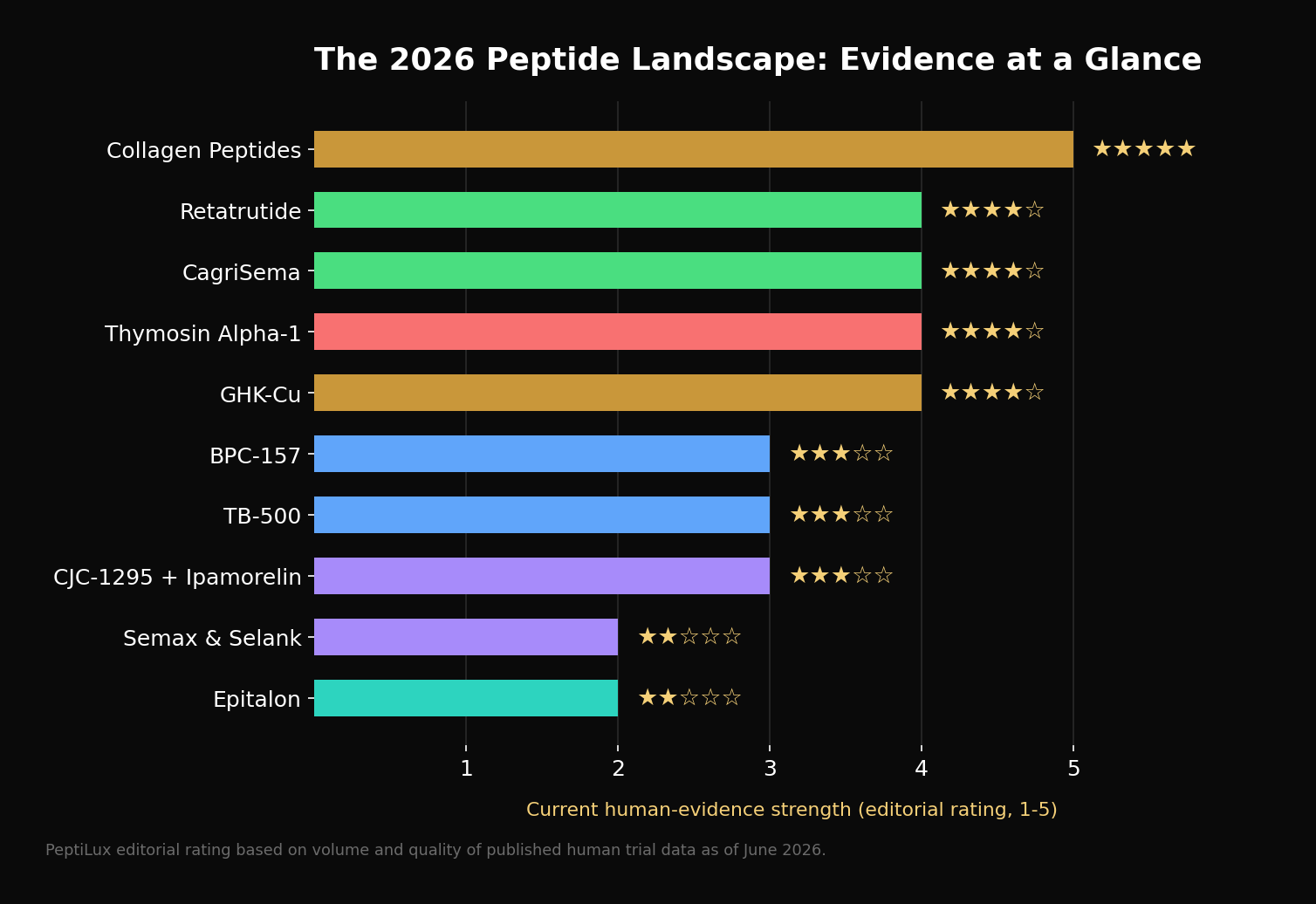
This guide ranks the ten peptides driving that growth and the conversation around it right now, organised by what people actually search for: weight loss, recovery, performance, skin, cognition, and longevity. For each one you will get what the research currently shows, where the regulatory line sits today, and an honest read on how strong the human evidence really is, not just the marketing copy.
22.7% average body weight reduction with the cagrilintide and semaglutide combination CagriSema in the REDEFINE-1 Phase 3 trial, outperforming either drug alone.
30% body weight reduction at 80 weeks with retatrutide's 12mg dose in the TRIUMPH-1 trial, the highest weight-loss efficacy ever recorded in a pharmaceutical trial of its kind.
12 peptides were removed from the FDA's 503A Category 2 safety-concern list on April 15, 2026, including several of the compounds on this list.
35+ countries have already approved thymosin alpha-1 for clinical immune use, years ahead of any equivalent US decision.

On July 23 and 24, 2026, the FDA's Pharmacy Compounding Advisory Committee meets to decide whether seven peptides recently cleared of "significant safety concern" status should be formally added to the list pharmacies are authorised to compound. Four of the ten compounds in this guide, BPC-157, TB-500, Epitalon, and Semax, are on that exact agenda. Nothing is guaranteed, and removal from the concern list is not the same as approval, but it is the clearest signal yet that regulators are taking a second look.
1. Collagen Peptides
Category: Skin & Joint SupportCollagen is the most abundant protein in the human body, making up roughly 30% of total protein content and providing structural integrity to skin, tendons, ligaments, cartilage, and bone. Production declines steadily with age and accelerates after intense training, sun exposure, or injury. Hydrolyzed collagen peptides are short-chain fragments broken down specifically to be more bioavailable and rapidly absorbed than whole collagen protein.
Collagen peptides remain the single most globally searched peptide category in 2026, ahead of creatine, whey, and vitamin D combined, a reflection of how accessible and well-studied the ingredient already is compared to anything injectable on this list.
"Oral supplementation of low-molecular-weight collagen peptides reduces skin wrinkles and improves biophysical properties of skin in a randomized, double-blinded, placebo-controlled study." Journal of Medicinal Food (2022)
"A 2026 systematic review and meta-analysis confirmed that both oral and topical peptides improve measurable skin aging markers." Frontiers in Medicine (2026), Nukaly et al.
- Skin elasticity and firmness: Signals fibroblasts to produce fresh collagen, improving skin density within 8 to 12 weeks of consistent use.
- Joint and cartilage support: Undenatured Type II collagen (UC-II) has shown significant reductions in knee osteoarthritis pain and stiffness at just 40mg daily.
- Tendon and ligament resilience: Supports connective tissue synthesis under repeated training load.
- Hair and nail strength: Rich in the amino acids that build keratin, with consistent user-reported improvements in both.
2. GHK-Cu (Copper Peptide)
Category: Skin & Anti-AgingGHK-Cu is a naturally occurring copper-binding tripeptide found in human plasma, saliva, and urine at its highest concentration in youth. Levels average around 200ng/ml at age twenty and decline to roughly 80ng/ml by age sixty, a drop that tracks closely with visible skin aging. Genomic research has linked GHK-Cu to the regulation of more than 4,000 human genes, one of the broadest documented footprints of any peptide under study.
"In a human trial comparing topical GHK-Cu to vitamin C and retinoic acid, GHK-Cu produced measurable collagen increases in 70% of volunteers, outperforming both comparators." PMC / National Institutes of Health (2021)
Across a separate 12-week trial, creams containing GHK-Cu significantly improved skin firmness, laxity, density, and wrinkle reduction around the eyes and face, alongside faster recovery from minor dermal injury. The mechanism runs through several pathways at once: stimulating collagen and elastin synthesis, acting as an antioxidant, reducing inflammatory signalling, and accelerating tissue remodelling.

GHK-Cu is most commonly used topically rather than injected, layered into serums alongside ingredients like Matrixyl and niacinamide. It is one of the few compounds on this list with both strong consumer accessibility and a multi-decade research trail behind it.
3. BPC-157
Category: Recovery & Tissue RepairBPC-157 is a synthetic 15-amino-acid peptide derived from a protective protein naturally found in gastric juice. It has been studied extensively in animal models for its effects on musculoskeletal healing, gut integrity, and neuroprotection, and is consistently one of the most discussed compounds in recovery-focused corners of the internet.
"Wound-healing peptides such as BPC-157, TB-500, and GHK-Cu promote angiogenesis, integrin-mediated cell migration, and tissue repair, mechanisms central to orthopaedic recovery." PMC / American Academy of Orthopaedic Surgeons (2026)
- Accelerated muscle fibre regeneration and reduced fibrosis in injury models
- Promotes satellite cell activation, the resident stem cells responsible for muscle repair
- Stimulates angiogenesis, improving nutrient delivery to injured tissue
- Anti-inflammatory and neuroprotective properties observed across preclinical studies
A 2025 systematic review (Vasireddi et al.) found BPC-157 well-tolerated across both preclinical and the limited clinical evidence published so far. On April 15, 2026, the FDA removed BPC-157 from its 503A Category 2 list of substances raising significant compounding safety concerns. That does not yet authorise pharmacies to compound it, but it cleared the path to the Pharmacy Compounding Advisory Committee meeting on July 23 and 24, 2026, where its case will be formally heard.
4. TB-500
Category: Recovery & Tissue RepairTB-500 is a synthetic fragment of Thymosin Beta-4 (Tβ4), a naturally occurring protein present in virtually all mammalian cells, where it regulates the cytoskeletal dynamics central to cell motility and wound repair. Paired with BPC-157, the combination has earned the informal name the Wolverine Protocol among research and recovery communities.
"TB-500 has more human clinical data than BPC-157. A Phase I safety trial tested doses from 42mg to 1,260mg over 14 days with no toxicity or serious adverse events." McAlpine Chiropractic Group / Integrative Recovery Review (2026)
What sets TB-500 apart is its systemic reach. Rather than acting only at the injection site, it circulates and can support tissue repair across multiple sites at once, including reported support for cardiac tissue repair after myocardial injury in human trials. Like BPC-157, TB-500 was cleared from the FDA's 503A Category 2 list on April 15, 2026, and sits on the same July PCAC review agenda.
5. CJC-1295 + Ipamorelin
Category: Performance & Sleep RecoveryCJC-1295 is a growth hormone-releasing hormone (GHRH) analogue that stimulates the pituitary gland to release more growth hormone over a sustained period. Ipamorelin is a selective GH secretagogue that triggers release through the ghrelin receptor without meaningfully raising cortisol or prolactin. Together they are often nicknamed the peanut butter and jelly of peptides: effective individually, considerably more effective combined.
"The Ipamorelin and CJC-1295 stack allows for consistent, non-spiked elevations in IGF-1 without the desensitisation risks seen with exogenous HGH." Swolverine Peptide Research (2025)
- Accelerated muscle recovery: Supports tissue regeneration and collagen formation, reducing time back to full training.
- Deep sleep optimisation: Amplifies the nocturnal growth hormone pulse that drives the body's hardest overnight repair work.
- Body composition: Promotes lipolysis, particularly of visceral fat, while supporting lean mass.
- Connective tissue support: Downstream IGF-1 production supports joint resilience and tendon health.

This stack is most commonly used in the evening, 30 to 60 minutes before sleep, to align with the body's natural nocturnal growth hormone pulse. Protocols vary considerably between individuals and should be tailored under clinician guidance.
The Peptide Edit
To continue reading for free
Enter your email and keep reading, no strings attached.

Already subscribed?
Explore the Research Catalogue
Every compound mentioned in our articles is available for research. Pharmaceutical-grade, HPLC-verified, shipped worldwide.
Browse All Compounds